


The Chain Wall Street Built That The Market Doesn’t Know What To Do With Yet
Arc is almost two weeks old.
And in that short time, it has already been celebrated, crashed, and eulogised.
But the people writing it off might be making the same mistake as the people who rushed in.
Because Arc is not a memecoin chain. It is not a Solana competitor. It is not just another Layer 1 hoping to find a purpose after launch.Arc is arguably the most institutionally backed blockchain ever created.
And it just opened its doors.
On September 16th 2026, Circle, the company behind USDC, launched Arc's public mainnet. Circle's CEO Jeremy Allaire called it the most significant launch in the company's history since USDC itself. He went further on an earnings call, describing it as "a bigger opportunity than USDC" and "the birth of a new operating system layer for economic activity in the world."
That is not the language of a company holding back.
The validator set tells you everything.
BlackRock. Visa. Mastercard. DTCC. ICE, the company that owns the New York Stock Exchange. Standard Chartered. MoneyGram. Worldpay. Galaxy. SBI Group. Sumitomo Corporation.
Eleven founding validators. Almost none of them crypto native.
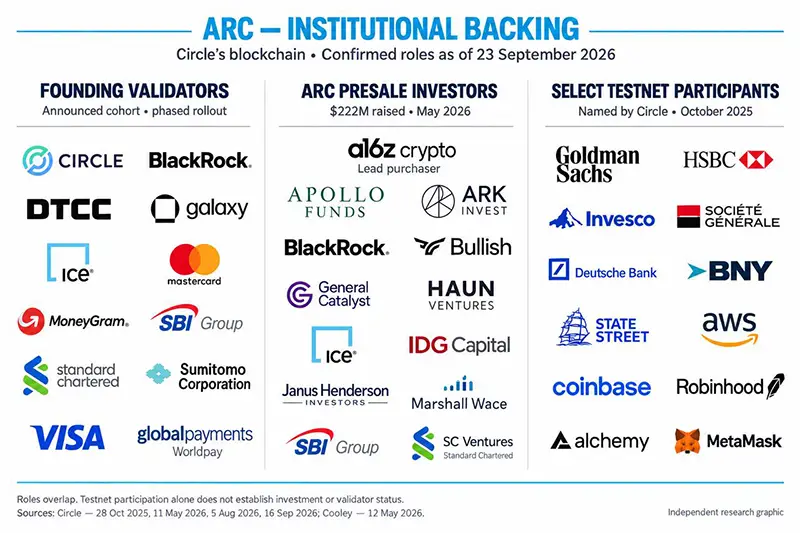
These are not advisors. They are not investors sitting doing nothing. They are running the nodes. They are producing and confirming blocks. The entities that clear the bulk of US securities transactions and process trillions of dollars in card payments are physically operating a blockchain.
That has never happened at this scale on a public chain.
But here is the thing.
The ARC token is not live yet.
The chain runs on USDC as its native gas token, meaning every transaction fee is priced in dollars. Circle minted all 10 billion ARC tokens the week of launch, but the token is not trading. Circle has floated launching it alongside a transition from proof of authority to proof of stake, potentially in 2027, though it says the mint isn't a commitment to a public launch.
For now, the chain is live, the validators are running, but the token is sidelined.

Within 24 hours of mainnet going live, users created more than 97,000 tokens. Memecoin launchpads generated $336 million in trading volume, roughly 82% of everything that moved on the chain. A single launchpad called Arguspad handled $202 million and minted 83,751 tokens by itself, more than 86% of every token created on Arc that day.
The chain processed 7.83 million transactions in its first 24 hours.
Only about 624,000 of those were USDC transfers.
The payments chain was not being used for payments. It was being used as a casino.
And then the casino collapsed.
By the next morning, most of the top memecoins had fallen 50 to 80% from their launch highs. One trader on X summed it up in two words: "It's cooked."
Another called it a one-day arc.
Even the winners were small.
The biggest token on the chain, $ARGUS, was worth just $16 million a day after launch.
$COOL, short for "usdc is cool," turned the chain's gas into a joke about USDC wearing pixel sunglasses. It still dropped 75% from its high.
The problem was the structure. Over ten memecoin launchpads had announced Arc deployments before mainnet even launched. Arguspad, Minara.fun, Tollylabs, Warp, Flipt, ArcPad, and others all went live at block one. All of them competing for the same limited pool of buyers. Liquidity was split across too many venues and too many tokens before consensus could form around any single one.
Some people also had USDC on Arc before mainnet through private access, positioned early on memes and launchpad tokens, and started dumping when public mainnet opened. That created the immediate feeling of being exit liquidity. Retail pulled back. Volume thinned. And everything bled.
Circle made it worse.
On launch day, Rachel Mayer, Circle's VP of Product for Arc, posted an AI-generated image of a terrier wearing an Arc medallion, captioned "The Duke of Arc." She wrote that she'd heard it was Jeremy Allaire's dog.
The post drew about 1 million views.
It also drew a wave of hostile replies accusing Circle of shilling a memecoin. This was a problem because a token called $DUKE already existed from the private mainnet, and after the tweet, degens created another one with the same ticker. Two $DUKEs. Both dumped.
One analyst commented: "You can clearly see a lot of their team fundamentally misunderstands meme culture. Now it's stuck in this weird middle ground where nobody really knows whether it's supposed to be a meme chain or a corporate stablecoin chain."
So one week in, the market has mostly written Arc off.
But the market might be wrong.
Look past the memecoins and the picture looks very different.
More than $300 million is still sitting on Arc. Not in memecoins. In lending protocols. People are depositing USDC into pools where others can borrow it, and earning from that. Quietly making money while the memecoin traders were losing theirs.
The infrastructure works. Fees are averaging three cents. The chain has not congested. Transactions settle in under a second.
Arc is live. The institutions are running it. What comes next has to be more than another wave of traders looking for something to buy.
Because having Wall Street operate a blockchain is one thing. Getting Wall Street to move its business onto it is another.
That is what Arc now must do.
The meme traders arrived, played, and left. Now we find out what the institutions came to do.