


Blockchain Layers: What They Are and Why They Exist
Many people imagine a blockchain as a single system doing everything.
One network. One chain. One place where all activity happens.
In reality, most modern blockchain ecosystems are built in layers.
These layers exist because blockchains face a difficult balancing act. A network needs to be secure, decentralized, and able to process activity at scale. Improving one of these qualities often makes the others harder to achieve.
Instead of solving everything in one place, different parts of the system handle different responsibilities.
Some layers provide security. Others improve speed, reduce costs, or support applications.
This layered structure has turned blockchain networks into something closer to a technology stack than a single piece of software.
Most blockchain ecosystems can be understood through several layers: Layer 0, Layer 1, Layer 2, and Layer 3. Some frameworks also include Layer 4, which represents the tools users interact with.

Layer 0: The Network Foundation
Layer 0 refers to the infrastructure that allows blockchains to exist and communicate with one another.
It includes networking protocols, interoperability systems, and development frameworks that allow new blockchains to be created.
Some Layer 0 projects focus on connecting multiple blockchains so that assets and information can move between them more easily. Two well-known examples are Polkadot and Cosmos.
These systems aim to create ecosystems of blockchains rather than isolated networks.
Layer 0 networks usually do not process everyday transactions themselves. Instead, they provide the foundation that other blockchains build on.

Layer 0 infrastructure helps different blockchains communicate and share information.
Layer 1: The Core Blockchain
Layer 1 is the main blockchain itself.
This layer records transactions, maintains the distributed ledger, and secures the network through consensus mechanisms.
Some of the most well-known Layer 1 blockchains include Bitcoin, Ethereum, and Solana.
Layer 1 networks are responsible for several core functions:
- Recording and storing transactions
- Securing the network through consensus
- Preventing double spending
- Maintaining decentralization across nodes
Because these networks prioritize security and decentralization, they often have limits on how many transactions they can process at once.
When large numbers of users interact with the network simultaneously, congestion can occur. Transaction fees may increase and confirmations can take longer.
These limitations are often described as part of the blockchain trilemma, which suggests that blockchains must balance security, decentralization, and scalability.
This is not necessarily a flaw. It is often a deliberate design choice.
To improve performance without sacrificing security, additional layers were built on top of Layer 1 networks.

Layer 1 blockchains maintain the core ledger and provide the security foundation of the network.
Layer 2: Scaling the Blockchain
Layer 2 networks are designed to increase transaction speed and reduce costs while still relying on the security of the base blockchain.
Instead of processing every transaction directly on the main chain, Layer 2 systems handle many transactions separately and later record the results on Layer 1.
This approach allows the main blockchain to remain secure while additional layers improve efficiency.
Several scaling solutions have been built on top of Ethereum, including Arbitrum and Optimism.
Users can perform transactions on these networks faster and often with significantly lower fees.
Different Layer 2 technologies exist, including rollups and sidechains, but they all aim to increase throughput while maintaining the security guarantees of the underlying blockchain.

Layer 2 networks increase speed and reduce fees by processing activity before settling results on the base chain.
Layer 3: Applications and Protocols
Layer 3 is where applications and services are built on top of blockchain infrastructure.
These include decentralized finance platforms, blockchain games, NFT marketplaces, and other blockchain-based services.
Many of these applications run on networks like Ethereum because of its programmable smart contract capabilities.
Examples include decentralized exchanges such as Uniswap and NFT marketplaces like OpenSea.
At this layer, users interact with applications rather than directly interacting with the blockchain itself.
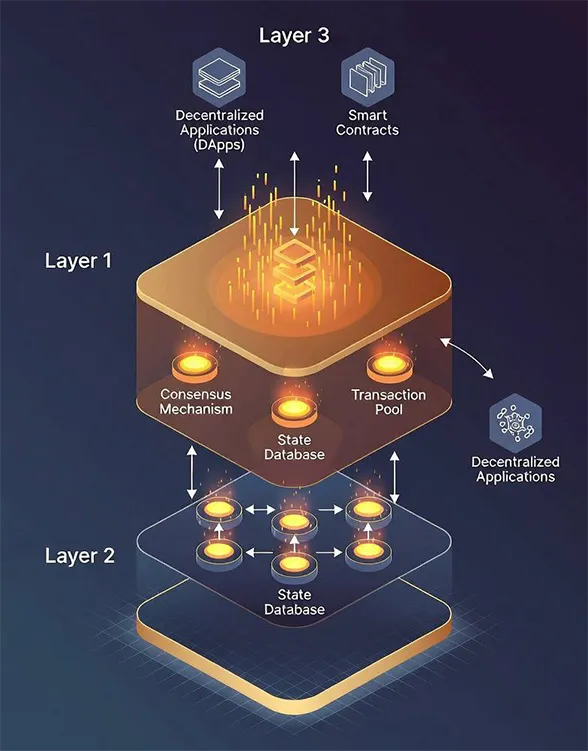
Layer 3 is where decentralized applications such as DeFi platforms and NFT marketplaces operate.
Layer 4: The User Access Layer
Some frameworks describe a final layer representing how users access blockchain systems.
This layer includes wallets, exchanges, and interfaces that connect people to blockchain networks.
For example, many users access decentralized applications through wallets like MetaMask.
These tools allow users to store private keys, approve transactions, and connect to blockchain-based services.
While Layer 4 tools do not operate the blockchain itself, they are essential because they provide the interface between complex blockchain infrastructure and everyday users.

Layer 4 tools such as wallets provide the interface between users and blockchain networks.
Why Blockchain Layers Exist
Blockchain layers exist because different parts of the system solve different technical challenges.
Some layers focus on security and decentralization. Others focus on scalability, interoperability, or usability.
Separating these responsibilities into layers allows blockchain networks to evolve without constantly modifying the base blockchain.
This layered approach also allows different parts of the ecosystem to evolve at different speeds. Core blockchains tend to change slowly because they secure large amounts of value and must remain stable. Higher layers can experiment more freely with new technologies, applications, and scaling techniques.
As a result, innovation often happens on the upper layers while the base blockchain focuses on reliability and long-term security. This separation allows networks to grow while keeping the core infrastructure stable.
The Takeaway
Blockchain technology is not just a single network.
It is a stack of layers working together.
Each layer serves a different purpose:
- Layer 0 connects networks
- Layer 1 secures the blockchain
- Layer 2 improves scalability
- Layer 4 provides user access
Together, these layers form the architecture that supports modern blockchain ecosystems.