
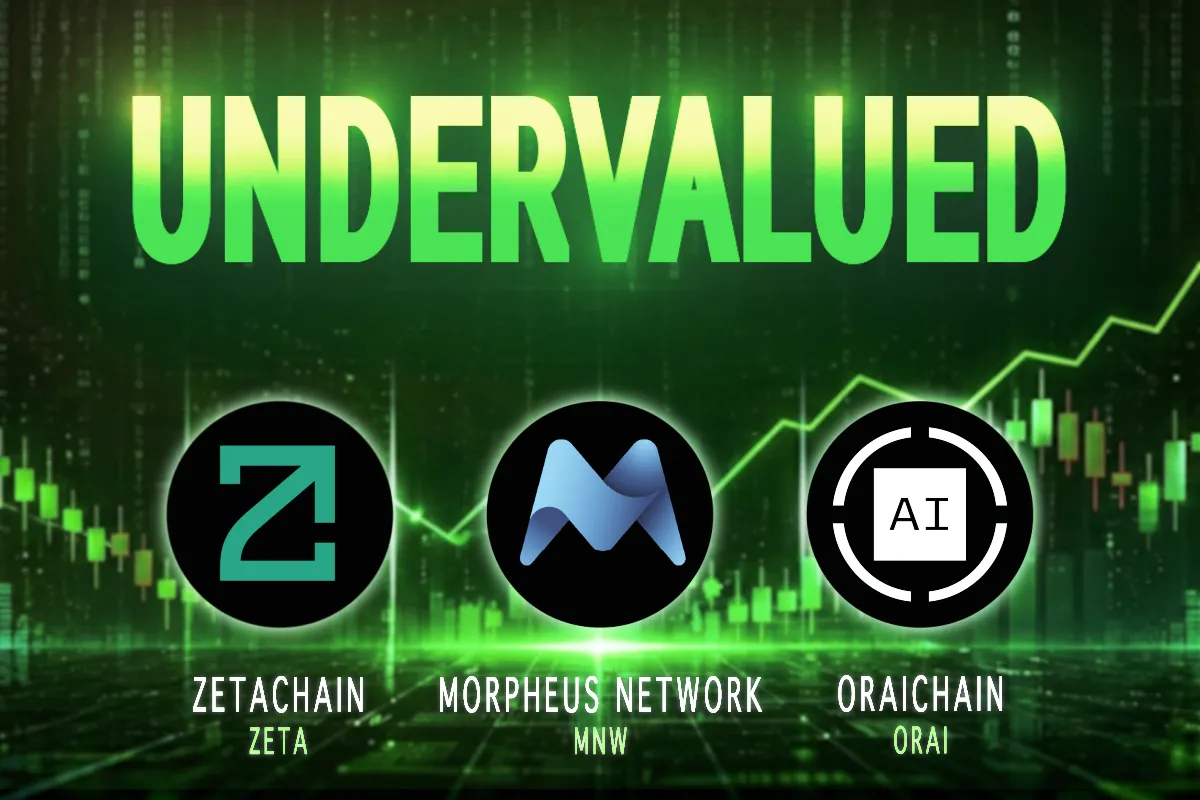
3 Undervalued Crypto Projects Flying Under the Radar: ORAI - MNW - ZETA
The crypto market has a pretty short attention span. Billions can flow into meme coins, while projects solving real infrastructure problems sit at market caps that make no sense relative to how much they have actually built.
These three projects caught our attention. None of them are that new. None of them are that hyped. But all of them have working products, real corporate partnerships, and market caps that suggest the market either forgot they existed or never really noticed them in the first place.
Oraichain (ORAI)
The AI Layer for Smart Contracts
Smart contracts execute logic, but they cannot think. They can do “if X, then Y,” but they cannot look at an NFT and tell you whether it’s fake and they can’t flag a suspicious website before a transaction goes through. That requires artificial intelligence, and right now there is no trustless way to plug AI into a blockchain.
Oraichain is trying to change that. The first AI-powered oracle network, enabling smart contracts to call AI models mid execution.
The practical applications are actually significant. A DeFi lending protocol could use an AI credit score derived from on-chain wallet behaviour to offer under collateralised loans instantly. An NFT marketplace could reject mints that are flagged as copies of existing works. A wallet could refuse to execute a transaction if the AI detects the contract is likely malicious.
They hold partnerships with TRON, Injective, and Oasis Network, and were recently listed on Solana via Raydium. The token sits at a market cap around $10 million. For a project that has been building since 2020 with a working product and active roadmap, that valuation is likely lower than it should be.

Morpheus.Network (MNW)
Automating Global Trade
Global supply chains still run on older fragmented systems, with manual paperwork, and disconnected processes across dozens of jurisdictions. Customs documents, shipping manifests, and payment triggers are often handled separately, by different parties, using different systems.
Morpheus.Network is a supply chain platform that automates the entire workflow using smart contracts. When a shipment clears customs, payment is released to the supplier. When goods arrive at port, the inventory system updates. When documents are required, they are filed automatically. No manual intervention required.
The platform has been live since 2019 and has over 150 integrations with companies including DHL, FedEx, SAP, Microsoft, and SWIFT. The former CEO of DHL, Roger Crook, sits on their board. They have worked directly with the Canadian Border Services Agency and the Argentine government agency SENASA. They have won multiple supply chain industry awards and were selected by Plug and Play, one of the world’s largest innovation platforms.
And the market cap is roughly $1 million.
That is not a typo. A project with enterprise clients, government partnerships, 150+ integrations, and a working product is valued at less than a single apartment in some capital cities.
There are reasons for this. Supply chain crypto as a narrative has been burned repeatedly, too many projects made big partnership announcements and never delivered meaningful results, and investors stopped paying attention to the entire sector.
Morpheus may be the most extreme example in crypto of a project where the product works but the token does not capture the value.
ZetaChain (ZETA)
One Smart Contract for Every Blockchain
Crypto built itself into a fragmentation problem. Ethereum, Solana, Bitcoin, BNB Chain, Arbitrum… each became is its own island. Moving assets between them requires multiple wallets, bridges or wrapped tokens. And bridges have historically been the most exploited infrastructure in the space.
ZetaChain is a Layer 1 blockchain designed so that developers can write a single smart contract that reads and writes across every connected chain, including non smart contract chains like Bitcoin and Dogecoin. With no bridges. The smart contract logic lives on ZetaChain and executes transactions on each connected network.
Let’s say you have DOGE. You want BTC.
Instead of using a centralised exchange or a bridge and then swapping, you interact with an application built on ZetaChain.
The app receives your DOGE, performs the required actions across chains, and sends native BTC to your Bitcoin wallet.
Founded by a former Coinbase engineer, ZetaChain has processed over 11 million cross-chain transactions since its mainnet launched in early 2024. Over 5,000 dApp contracts have been deployed and the ecosystem includes more than 250 developer partners.
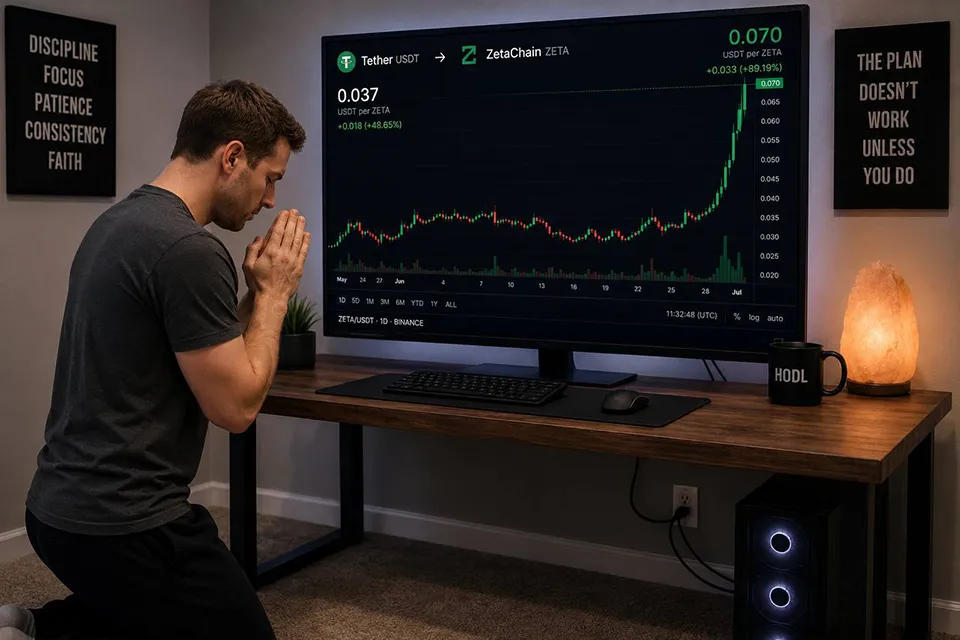
They have also moved into AI integration, launching a layer that allows AI agents to execute cross-chain actions autonomously. At a market cap of roughly $50 million, ZetaChain is one of the more established projects on this list, but still trades significantly below its all-time high price of $650 million, despite being one of the few omnichain platforms with a live, functioning product.
Now.
None of these three projects are trying to be the next viral token. They are middleware, the invisible infrastructure that sits between the user and the blockchain to make things actually work. Oraichain gives smart contracts intelligence. Morpheus.Network connects global trade to the blockchain. ZetaChain connects the blockchains to each other.
The market tends to reward what is visible and ignore what is foundational. But the projects that quietly become essential infrastructure have a way of mattering long after the hype cycles fade. Whether any of these three achieve that remains to be seen. But the products are there, the partnerships are real, and the problems they are solving are not going away. At some point, the market either has to notice, or another project has to do what they’re doing, but better.